
You have answered forty emails, sat through three meetings, and updated your task tracker twice. It’s 6 PM and the one thing you actually needed to finish today is still sitting untouched. That gap between feeling busy all day and having something real to show for it is not a discipline problem. It is usually a structural one, and it’s exactly what separates efficiency from motion.
Why “Busy” and “Productive” Aren’t the Same Thing
Busy measures activity. Productive measures output. You can be fully occupied for eight hours and still fall behind, because being occupied says nothing about whether the work being done actually moves anything forward.
| Signal | Busy | Productive |
|---|---|---|
| Focus | Reactive — responds to whatever appears next | Proactive — works from a set priority list |
| Measure of success | Hours worked, inbox cleared | Tasks completed that actually mattered |
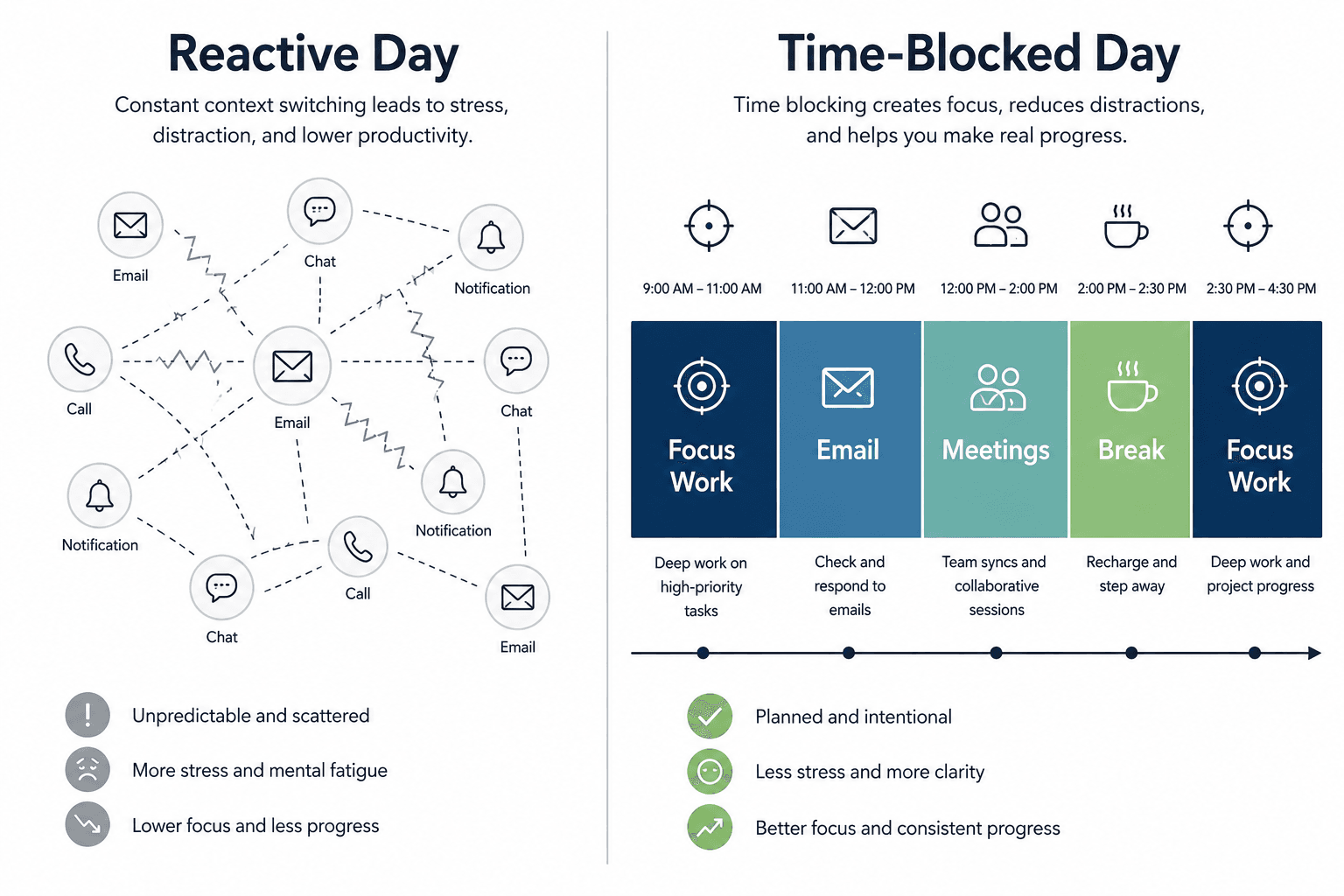
| Typical day | Constant task-switching, frequent interruptions | Blocks of uninterrupted, single-task time |
| End-of-day feeling | Exhausted, unclear what got accomplished | Tired but able to name specific results |
Table: the practical difference between spending a day busy and spending a day productive.

What Efficiency at Work Actually Means
Efficiency is output relative to input, how much you get done for the time and effort you put in. Productivity is a related but different measure: total output, regardless of how much effort it took to get there. A person can be highly productive and still inefficient, grinding out results through sheer hours rather than a better process.
This distinction matters because most advice on increasing productivity in workplace settings focuses on doing more. Efficiency asks a sharper question: could the same result have taken less effort, less time, or fewer interruptions? That reframing is what turns generic productivity tips into something you can actually act on.
The Real Cost of Multitasking (And Why It Feels Productive)
Multitasking feels efficient because you’re doing several things “at once.” The research on this is unusually consistent, and it says the opposite is true.
According to the American Psychological Association’s research on task switching, the brief mental blocks created when people switch between tasks can cost as much as 40% of someone’s productive time. What feels like multitasking is actually rapid task-switching — the brain isn’t running two processes at once, it’s repeatedly stopping one and restarting another, and each restart has a cost.
| What It Feels Like | What’s Actually Happening | Real Cost |
|---|---|---|
| “I’m getting more done at once” | Brain is rapidly switching focus, not running tasks in parallel | Up to 40% of productive time lost to switching costs |
| “A quick Slack reply won’t hurt my focus” | Each interruption forces a full context reload afterward | Refocusing after an interruption can take several minutes, not seconds |
| “I work better under constant pressure” | Sustained task-switching increases errors, not just time lost | Higher error rates on the switched-to and switched-from task alike |
Table: what multitasking feels like versus what the research shows is actually happening.
This is the core reason single-tasking methods keep outperforming “always available” work styles, not because they sound disciplined, but because switching costs are a measurable tax on every context change.
How to Increase Efficiency at Work: Core Methods
These aren’t generic tips. Each one addresses a specific, common reason a full day produces less than it should.
| Method | What It Fixes | How to Apply It |
|---|---|---|
| Time-block your calendar | Reactive, meeting-driven days with no protected focus time | Block 90-minute focus windows before the day fills with meetings |
| Batch similar tasks | Constant context-switching between unrelated task types | Group emails, calls, and admin into fixed windows rather than scattering them |
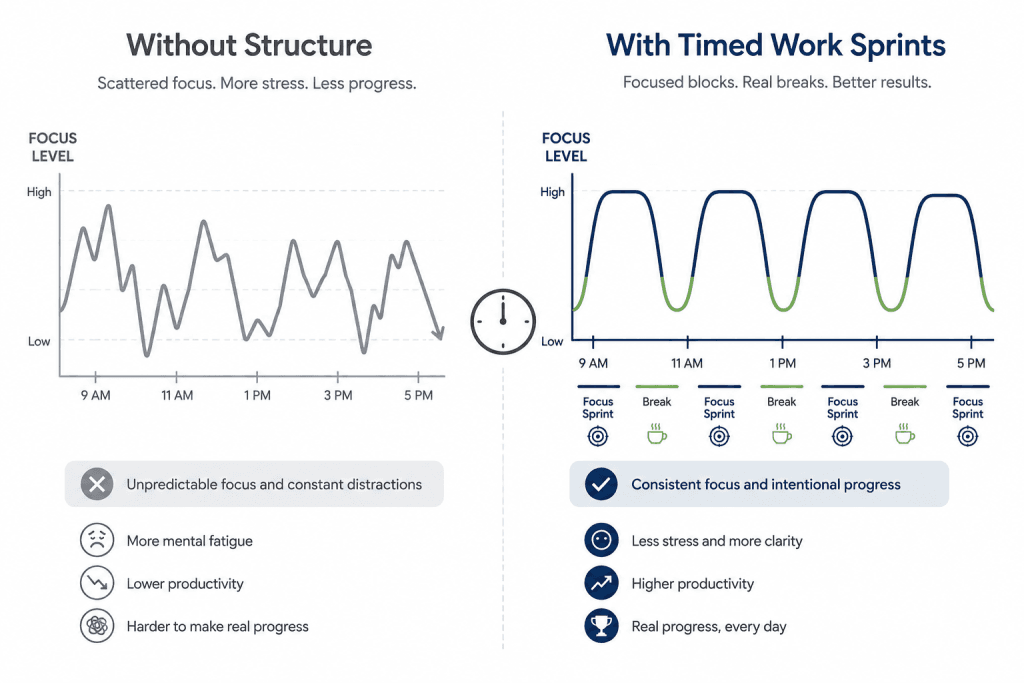
| Use timed work sprints | Sustained focus fatigue and gradual attention drift | Work in fixed intervals (25–50 minutes) with a genuine break in between |
| Set a single daily priority | A full task list with no clear “most important” item | Name one task that must get done before anything else, every morning |
| Turn off non-urgent notifications | Constant low-grade interruptions during focus time | Mute Slack/email during blocked focus windows, not just during meetings |
Table: five specific methods for increasing efficiency at work, and the exact problem each one addresses.
The Pomodoro Technique: Why Structured Breaks Beat Willpower
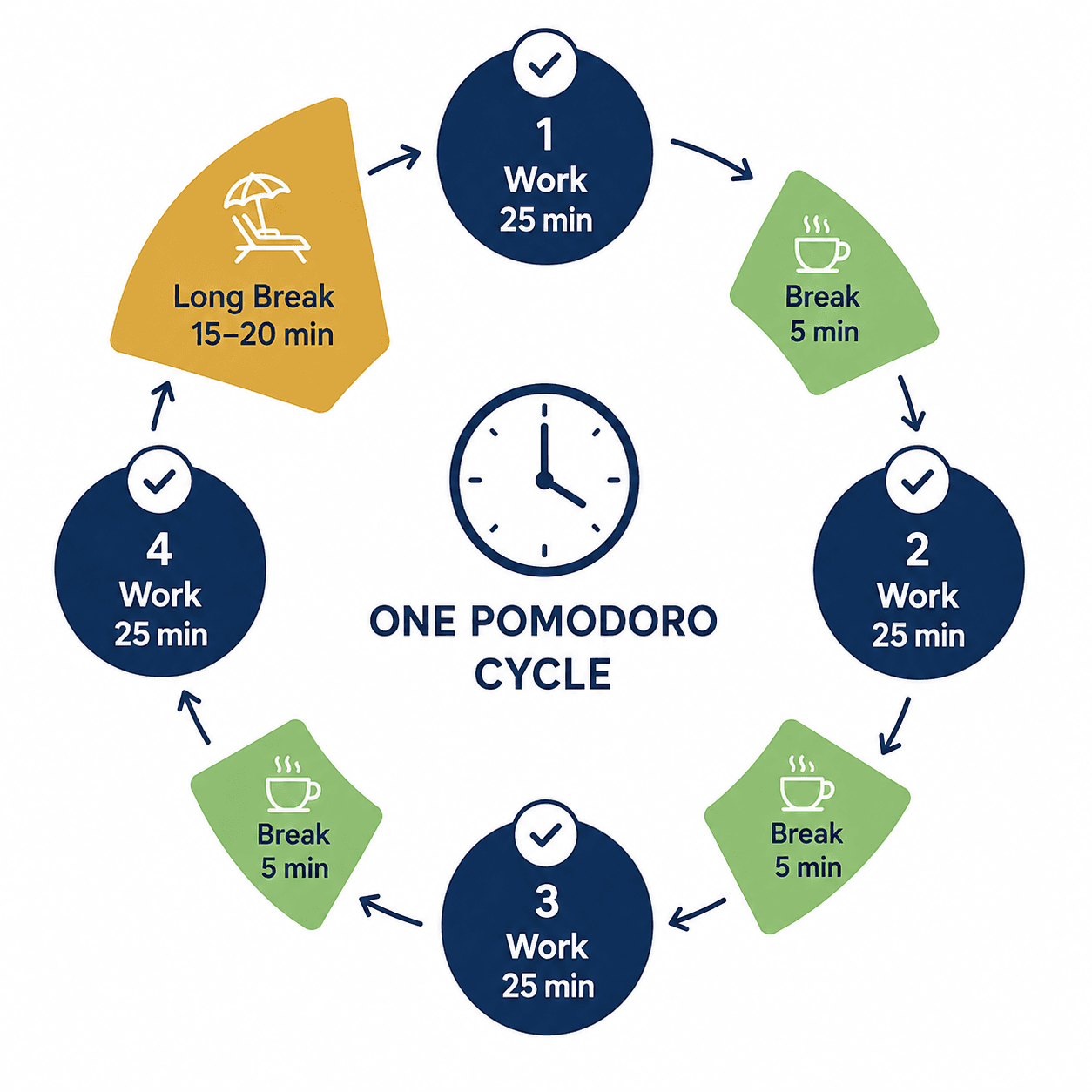
The Pomodoro Technique works in a focused 25-minute block, then you take a 5-minute break, repeat, then take a longer break after four rounds, and was developed by Francesco Cirillo in the late 1980s. It’s one of the most studied time-management methods, and the research consistently points to the same mechanism: breaks aren’t a reward for finishing work; they’re what make sustained focus possible in the first place.
| Finding | What It Shows |
|---|---|
| Brief diversion research (University of Illinois) | Short breaks restore attentional resources that decline during prolonged focus on one task |
| Ultradian rhythm research | Human concentration naturally fluctuates in roughly 90-minute cycles, making fixed-interval work more sustainable than open-ended sessions |
| 2025 scoping review of 32 Pomodoro studies (N=5,270 across studies) | Predictable work-break cycles positively affect attention, cognitive load, and task productivity across multiple study designs |
Table: what the research actually shows about why timed work-break cycles improve focus.
In practice, this is simpler than the research makes it sound. A free online Pomodoro timer handles the interval tracking for you — set 25 minutes, work on one task only, take the break when it rings, and repeat. No app download, no account, and no physical kitchen timer required, though the method traces back to exactly that: Cirillo’s original tomato-shaped kitchen timer, which is where “Pomodoro” (Italian for tomato) comes from.
How to Increase Team Productivity at Work
Team-level efficiency has different failure points than individual efficiency, usually coordination overhead rather than personal focus.
| Team Problem | Fix |
|---|---|
| Meetings that could have been a message | Default to async updates; reserve live meetings for actual discussion or decisions |
| No shared sense of priority | Agree on one team-wide priority per week, visible to everyone |
| Constant cross-interruptions | Set shared “focus hours” where the team avoids pinging each other |
| Unclear task ownership | Assign a single owner per task, even on collaborative work |
| Status updates eating into work time | Replace status meetings with a shared, asynchronous tracker |
Table: the most common team productivity problems and direct fixes for each.
The instinct to increase team productivity at work by adding more check-ins usually backfires, it adds coordination overhead without adding focus time. Shared “focus hours,” where the whole team blocks out interruption-free time together, tend to outperform more frequent syncing.
How to Increase Productivity Working From Home
Remote work removes commute time and office interruptions, but introduces its own set of focus problems, usually ones that are easy to underestimate until they’re actually costing you hours.
| WFH Challenge | Fix |
|---|---|
| No physical boundary between work and home | Keep a fixed work location, even a specific desk corner, used only for work |
| Household distractions during focus time | Use a visible signal (closed door, headphones) to mark focus blocks |
| Isolation reducing motivation | Schedule short, regular check-ins with colleagues, not just when something’s needed |
| Blurred start/end times leading to burnout | Set a fixed shutdown time and stick to it, same as an office would enforce |
| Constant home-related interruptions | Use timed sprints so focus periods are short enough to genuinely protect |
Table: the specific challenges behind working from home productivity, and practical fixes for each.
How to Increase Productivity While Studying
Study sessions fail for a slightly different reason than work tasks do: the goal is often vague (“study for the exam”) rather than concrete, which makes it easy to sit down for hours without clear progress.
| Study Problem | Fix |
|---|---|
| Vague goals (“study biology”) | Set a specific target per session: “finish chapter 4 practice questions” |
| Phone checking mid-session | Physically separate the phone from the study space during work blocks |
| Long, unbroken study marathons | Use timed intervals with real breaks rather than pushing through fatigue |
| Re-reading instead of active recall | Test yourself on material instead of just rereading notes |
Table: common study productivity problems and specific fixes for each.
A 2025 scoping review across six academic databases found consistent evidence that structured, predictable work-break cycles positively affect attention and task performance in learning contexts specifically, not just general office work, which is part of why timed study sprints have become a standard recommendation in study-skills guidance rather than just a workplace trend.
Common Efficiency Mistakes That Look Like Productivity
| Mistake | Why It Backfires |
|---|---|
| Answering every message immediately | Trains constant interruption instead of protecting focus blocks |
| Working longer hours instead of fixing the process | Adds time without addressing the actual source of inefficiency |
| Keeping a huge, unprioritized to-do list | Every task looks equally urgent, so nothing gets clear priority |
| Treating meetings as the default communication tool | Adds scheduling overhead for things that could be a short message |
| Skipping breaks to “push through” | Attention degrades with sustained focus regardless of willpower |
Table: efficiency mistakes that feel productive in the moment but reduce actual output.
Advanced Tips for Long-Term Efficiency
- Audit your calendar monthly. Recurring meetings tend to outlive their usefulness — check whether each one still needs to exist at its current frequency.
- Match task difficulty to your energy curve. Do demanding, complex work during your natural peak-focus hours, and save routine tasks for lower-energy periods.
- Protect the first work block of the day. Checking email first thing sets the entire day’s tone to reactive rather than intentional.
- Track where time actually goes for one week. Most people significantly underestimate how much time meetings and context-switching consume until they measure it directly.
- Rest is part of the system, not a break from it. Structured downtime isn’t lost productivity it’s what makes the next focus block possible.
Try a Free Pomodoro Timer
Every method covered here works better with genuine external structure than with willpower alone to track intervals. Our free Pomodoro Timer runs the classic 25-minute work and 5-minute break cycle directly in your browser, no signup, no app download, and no account required.
- Standard 25-minute focus sessions with automatic short and long breaks
- Customizable interval lengths if the default 25/5 split doesn’t fit your workflow
- Works for individual focus sessions, study sprints, or shared team focus blocks
- Runs entirely in your browser, nothing to install, nothing tracked
Frequently Asked Questions
What is the difference between being busy and being productive?
Being busy measures how much activity fills your time; being productive measures how much of that activity actually produced a meaningful result. You can be fully occupied all day while making little real progress on what matters.
How can I increase efficiency at work without working longer hours?
Focus on reducing the cost of context-switching rather than adding more hours. Time-blocking, batching similar tasks, and using timed work intervals all address the actual source of lost time rather than compensating for it with extra effort.
Does multitasking actually reduce productivity?
Yes. According to APA research on task switching, the mental cost of shifting between tasks can consume up to 40% of someone’s productive time, since the brain handles tasks sequentially rather than in true parallel.
How does the Pomodoro Technique improve efficiency?
It structures work into short, focused intervals (typically 25 minutes) followed by real breaks, which research shows helps restore attentional resources that decline during sustained focus rather than relying on willpower to sustain concentration indefinitely.
How can I increase productivity working from home specifically?
Set a fixed physical work location, protect start and end times the same way an office schedule would, and use short, timed work sprints to make focus periods easier to actually defend against household distractions.
Is a free online Pomodoro timer as effective as a paid app?
For the core method timed intervals with real breaks a free browser-based timer does the same job as a paid app. The technique’s effectiveness comes from the structure itself, not from extra features layered on top of it.
Conclusion: Key Takeaways
- Being busy and being productive are measured differently activity versus actual output and confusing the two is one of the most common reasons a full day still feels unproductive.
- Multitasking has a measurable cost: up to 40% of productive time lost to task-switching, according to APA research.
- Structured methods time-blocking, task batching, and timed work sprints like the Pomodoro Technique consistently outperform relying on willpower alone.
- Team and remote work efficiency both have their own specific failure points, and both respond better to structural fixes than to working longer hours.
- You can put timed work sprints into practice immediately with the free Pomodoro Timer, no signup, no download, ready whenever you are.
Also Try These Productivity Tools
- Free To-Do List Online: Minimalist Visual Task Manager
- Study Break Calculator
- Timetable Generator – Free Online Tool to Build Your Schedule
- Cornell Notes Template – Free Online Maker (Fill In or Print)
- Deadline Countdown Timer – Free Tool for Any Task
Read Also:
- 5 Free AI Certification Courses Worth Your Time in 2026 (Plus How to Show It Off)
- Free CV & Resume Review Online: Get Your Instant Score Out of 100 (No Signup)
- What Is SWOT Analysis? Free Online SWOT Analysis Tool & Template
- How to Write a Personal SWOT Analysis for Students (With Practical Examples and Free Tool)
- How to Make an Online Invoice for Free: Step-by-Step Guide (No Software Needed)