
You spend hours getting the wording right on a CV or resume, then send it into a silence that lasts weeks. Most of the time, the problem isn’t your experience. It’s smaller than that: a typo you stopped seeing after the tenth read, a string of “responsible for” bullets that say nothing, a date format that switches halfway down the page. None of that shows up when you’re the one reading it. It shows up instantly to a recruiter, and by then it’s too late.
What Does a “CV Review” or “Resume Review” Actually Mean?
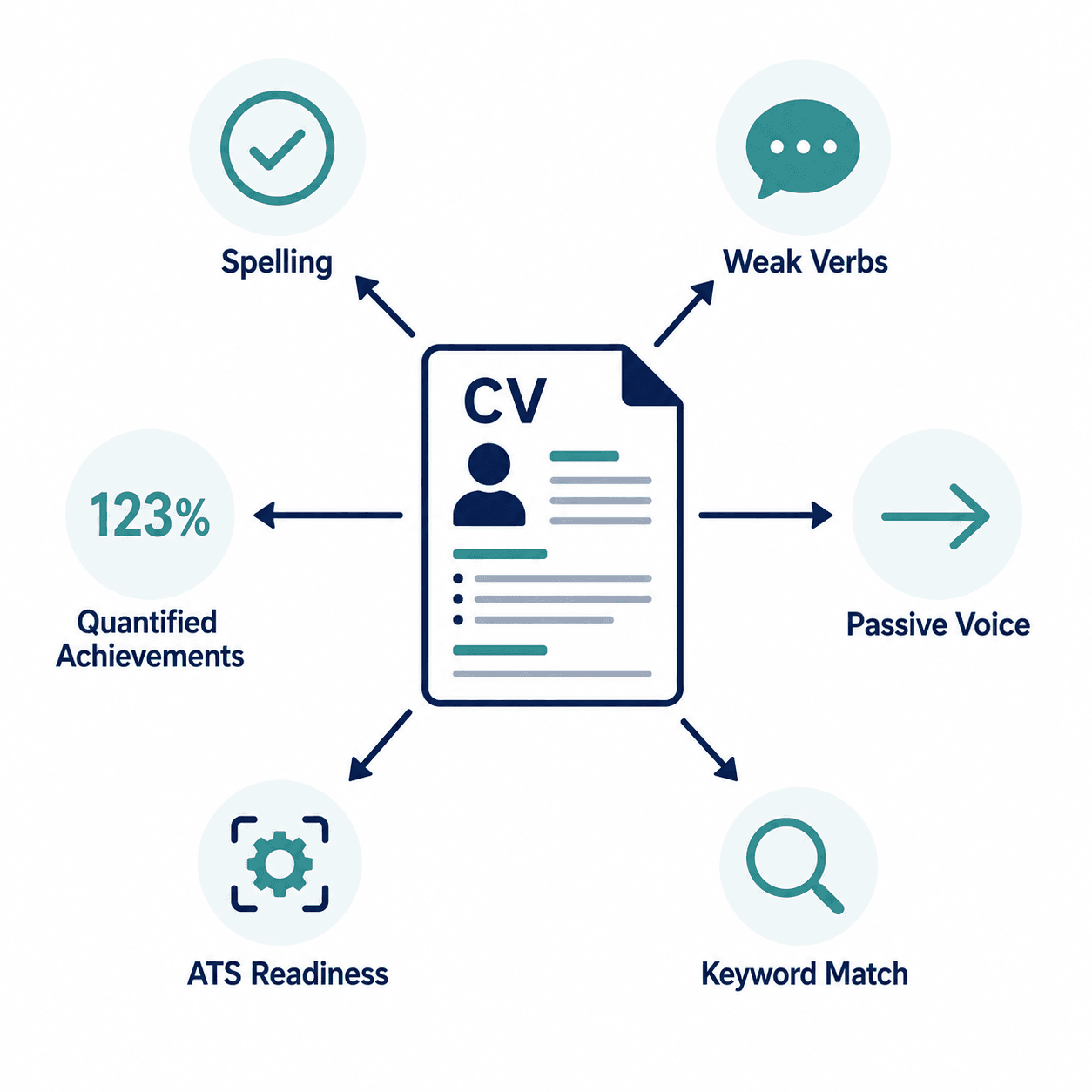
A CV review (or resume review, if you’re in the US or Canada) is simply a structured check of your document against the things that actually influence hiring decisions spelling and grammar, formatting consistency, weak versus strong verbs, whether your achievements are backed by numbers, and whether your document is readable by the software most employers now use to sort applications.
It’s not the same as someone just reading your CV and telling you it “looks fine.” A proper review breaks your document into specific, fixable categories, tells you exactly what’s wrong in each one, and ideally shows you how to fix it. That’s the difference between vague feedback and a review you can actually act on.

Why a Free CV or Resume Review Matters More Than You’d Think
A few numbers are worth knowing before you send out your next application:
- 97.8% of Fortune 500 companies use an Applicant Tracking System (ATS) to manage incoming applications, according to Jobscan’s 2025 ATS Usage Report. Formatting and keyword clarity genuinely matter, because this software is how nearly every large employer processes what you send.
- 61% of hiring managers say they’ll reject a candidate outright over a single typo, according to a CareerBuilder survey reported by softgarden’s analysis of hiring manager behavior. This isn’t the software rejecting you — it’s a human being, on the first pass.
- Recruiters spend an average of 7.4 seconds on the initial screen of a resume, based on The Ladders’ eye-tracking research, summarized by The Interview Guys’ breakdown of that study. That’s barely enough time to register your job titles, let alone your carefully worded bullet points.
Here’s what’s worth correcting, though: the claim that “75% of resumes are rejected by ATS before a human ever sees them” — repeated constantly across career blogs has been traced back to a 2012 marketing pitch from a company that went out of business the following year, with no published research behind it. A 2025 study of 25 recruiters by Enhancv, reported by HR Gazette, found that 92% of ATS platforms don’t auto-reject applications based on content at all; they organie and rank them, and a human still makes the final call.
That distinction matters for how you should actually spend your effort. The real risk isn’t a robot silently discarding your CV. It’s a real person, skimming for seconds, hitting a typo, a wall of passive verbs, or a section they can’t quickly find — and moving on to the next one.
What a Good CV or Resume Review Actually Checks
Not every “review” checks the same things. Here’s what separates a genuinely useful one from a surface-level glance.
| Check | What It Catches | Why It Matters |
|---|---|---|
| Spelling & grammar | Misspellings, doubled words, UK/US dialect mismatches | The single most common reason for instant rejection, per hiring manager surveys |
| Weak verbs | “Responsible for,” “worked on,” “helped with” | Passive, duty-based phrasing reads as low-impact next to achievement-led bullets |
| Passive voice | Constructions like “was managed” or “were handled” | Active voice is shorter and claims direct ownership of results |
| Quantified achievements | How many bullets contain a number, percentage, or figure | “Increased sales” is a claim; “increased sales 23%” is evidence |
| ATS readiness | Detectable contact details, standard headings, consistent dates | Determines whether the parsing software reads your document correctly |
| Keyword match | Overlap between your CV and a specific job description | Recruiters searching an ATS database filter by these exact terms |
Table: the core categories a thorough CV or resume review should cover, and why each one affects your chances.
Free vs. Paid vs. AI CV Review: Which Should You Actually Use?
Searches for “cv review service,” “resume review service,” and “review by experts” are all rising, alongside “ai cv review” and “ai resume review.” They’re not really competing for the same job, though each fits a different stage of your job search.
| Review Type | Typical Cost | Turnaround | Best For |
|---|---|---|---|
| Free AI/browser-based checker | $0 | Instant | Catching spelling, formatting, and ATS issues before you send anything |
| Paid expert review service | $100–$400+ | 2–5 business days | Career changers or senior candidates who need positioning and narrative advice, not just error-checking |
| Community feedback (forums, Reddit) | $0 | Hours to days, unpredictable | General impressions and second opinions, not consistent scoring |
| LinkedIn contact review | $0 (favor-based) | Variable | Industry-specific feedback, if you already know someone in your target field |
Table: how free, paid, and community CV review options actually compare on cost, speed, and what they’re good for.
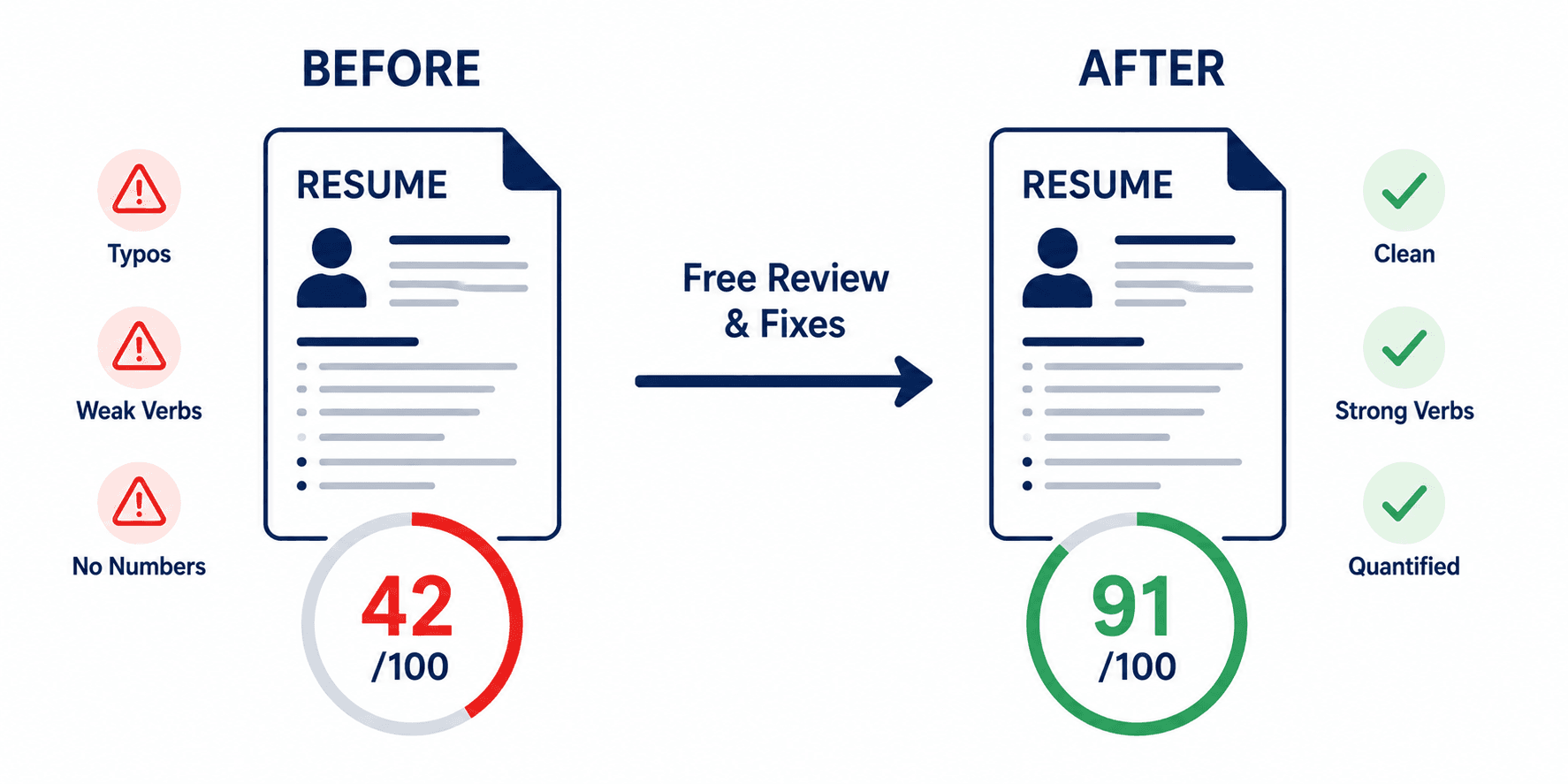
A sensible approach is sequencing, not picking one: run a free instant check first to clear out the mechanical problems — typos, weak verbs, missing sections, before you ever pay for or ask for a deeper opinion on positioning. There’s little point paying an expert to tell you about a typo a free tool would have caught in three seconds.
How Your CV or Resume Gets Scored Out of 100
A single overall number is only useful if you know what’s feeding into it. Here’s a standard breakdown, based on the four sub-scores used in our own free CV Review tool:
| Sub-Score | Weight | What Lowers It |
|---|---|---|
| ATS Readiness | 30% | Missing email/phone, non-standard section headings, inconsistent dates, unusual characters |
| Content Quality | 30% | Missing sections, weak verbs, buzzwords, unquantified achievements |
| Language & Readability | 25% | Spelling errors, passive voice, overlong sentences, AI-sounding phrasing |
| Formatting | 15% | Inconsistent bullets, mixed date styles, repeated words |
Table: how a 100-point CV score typically breaks down across four weighted categories.
The grading bands that follow from this are fairly consistent across most serious tools: 85 and above is Excellent, 70–84 is Good, 55–69 means the CV needs work, and anything below 55 usually signals multiple issues stacking up at once — spelling mistakes, weak verbs, and missing achievements together, not just one.
Step-by-Step: How to Get a Free Instant CV or Resume Score
| Step | What to Do |
|---|---|
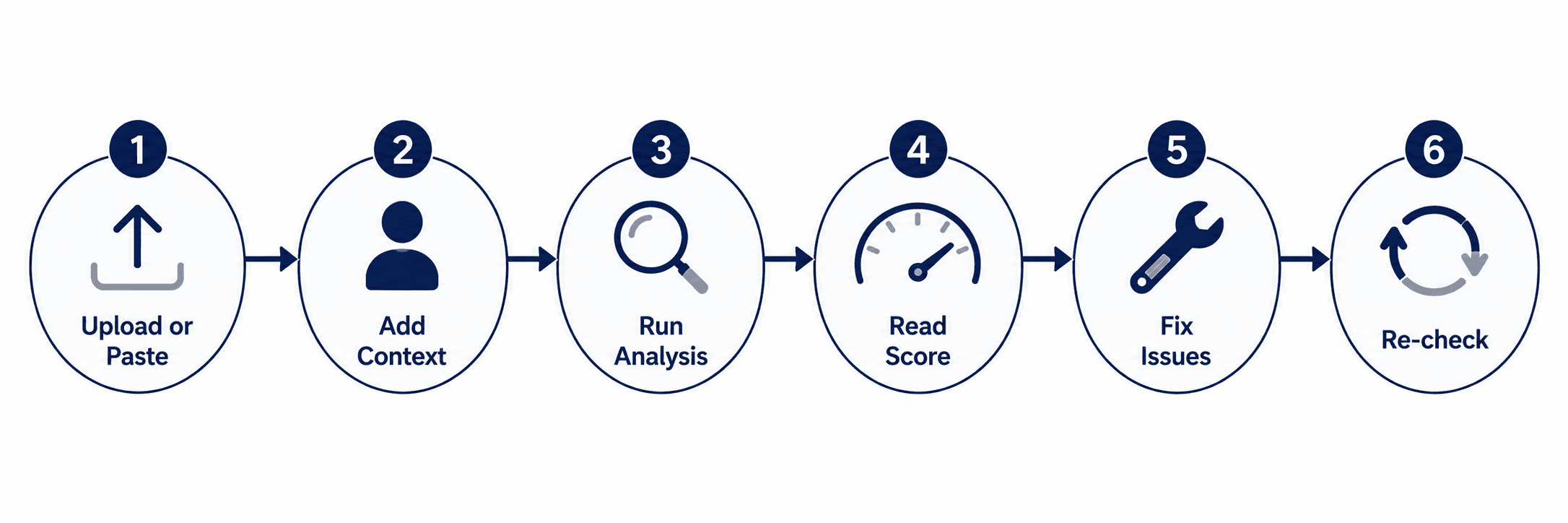
| 1. Upload or paste | Add a PDF, DOCX, or TXT file, or paste your CV text directly — no account needed |
| 2. Add context (optional) | Note your experience level and target job level for a more accurately calibrated score |
| 3. Run the analysis | Every check runs in seconds — spelling, ATS readiness, weak verbs, and more |
| 4. Read the score breakdown | Review your overall score and the four sub-scores behind it |
| 5. Work through the issues | Each flagged issue shows the exact text and a suggested fix |
| 6. Apply fixes and re-check | Use one-click corrections, then re-run the analysis to confirm your score improved |
Table: the six-step process for getting and improving your free CV score.
CV vs. Resume: Does It Matter Which One You Upload?
Search interest in “cv vs resume” and “what is a cv vs resume” has grown sharply in the past year, which suggests a lot of people genuinely aren’t sure which document they’re supposed to be sending.
| Feature | CV | Resume |
|---|---|---|
| Typical length | 2 pages or more, can grow with career history | 1–2 pages, tightly edited |
| Common regions | UK, Europe, most of the world | US, Canada |
| Content scope | Full career and academic history | Tailored highlights relevant to one specific role |
| Used for | Academic, medical, and most non-US job applications | Most private-sector US job applications |
Table: the practical differences between a CV and a resume, and where each one is expected.
For scoring purposes, this distinction barely matters, a good review checks the same fundamentals either way: spelling, structure, strong verbs, and quantified achievements. What changes is length expectations and regional formatting conventions, not the underlying quality bar.
Common Mistakes That Tank a CV or Resume Score
| Mistake | Fix |
|---|---|
| Using “responsible for” throughout | Replace with a strong action verb: Led, Built, Delivered, Reduced, Owned |
| Listing duties instead of outcomes | Rewrite each bullet to show a measurable result, not just a task |
| Mixing date formats across sections | Pick one style — “Jan 2023” or “01/2023” — and use it everywhere |
| Copying buzzwords from job ads | Replace “team player” and “hard worker” with a specific, evidenced example |
| Sending the same CV to every job | Adjust keywords and emphasis to match each specific job description |
Table: the five most common CV and resume mistakes, and the direct fix for each.
Reading Your Score: What “Good” Actually Looks Like
| Score Range | Grade | What It Usually Means |
|---|---|---|
| 85–100 | Excellent | Clean spelling, strong verbs, quantified achievements, ATS-ready formatting |
| 70–84 | Good | Solid overall, but with a few specific, fixable issues remaining |
| 55–69 | Needs Work | Multiple issues stacking — often weak verbs plus missing quantified results |
| Below 55 | Poor | Spelling errors, missing sections, and formatting problems compounding together |
Table: what each CV score band typically indicates about the underlying document.
Advanced Tips to Push Your Score Higher
- Fix spelling first. It’s the fastest win and the one most likely to cause an instant human rejection regardless of everything else on the page.
- Quantify at least half your bullets. A number, percentage, or dollar figure turns a claim into evidence — “improved onboarding” versus “cut onboarding time 35%.”
- Match your CV to the specific job description, not a generic version of your career. A tailored keyword match consistently outperforms a one-size-fits-all document in ATS searches.
- Re-check after every edit. A score isn’t a one-time snapshot — it should move as you fix things, and re-running the analysis confirms whether a change actually helped.
- Watch for AI-sounding phrasing like “proven track record” or “fast-paced environment.” Recruiters increasingly recognize these patterns, and generic phrasing does less work than a specific example.
Try It Free: CV & Resume Review Tool
Our free CV Review tool runs every check covered in this guide spelling, weak verbs, passive voice, ATS readiness, quantified achievements, buzzwords, and keyword matching against a job description and gives you an animated score out of 100 in seconds.
- No signup, no email wall, no teaser score hidden behind a paywall
- Upload a PDF, DOCX, or TXT file, or simply paste your text
- Everything is analyzed entirely in your browser — your CV is never uploaded to a server
- One-click corrections apply every spelling fix at once
- Download a full report or a visual PDF summary to keep or share
Frequently Asked Questions
What is the best free CV review online?
A browser-based checker that scores your CV out of 100 and shows every issue with its exact fix — without an email wall, a hidden teaser score, or an upload to a third-party server. A good one checks spelling, weak verbs, passive voice, ATS readiness, and keyword match, all in one pass.
Is a free AI CV review as good as a paid expert review?
For mechanical issues spelling, formatting, weak verbs, missing sections, ATS readiness — a free AI-based tool catches these instantly and consistently. A paid expert review adds more value for career changers or senior candidates who need help with narrative and positioning, not just error-checking. Most job seekers benefit from running a free check first, then deciding whether a paid review is worth it for their specific situation.
Does an ATS really reject 75% of resumes automatically?
No. That figure traces back to a 2012 marketing claim from a company with no published research, and more recent studies of practicing recruiters have found the large majority of ATS platforms don’t auto-reject applications based on content — they organize and rank them for a human to review.
What does a CV or resume score out of 100 actually measure?
It’s typically a weighted blend of four categories: ATS readiness, content quality, language and readability, and formatting. Each starts at 100 and loses points for specific, visible issues, so the score and the fix list should always match up.
Does it matter if I upload a CV or a resume?
Not for the core checks. Spelling, weak verbs, passive voice, and quantified achievements matter the same way regardless of which document format you’re using — the difference between a CV and a resume is mainly length and regional convention, not underlying quality standards.
Is my CV data safe when I use a free online checker?
It depends on the tool. Look specifically for one that analyzes your document entirely in your browser rather than uploading it to a server — your CV contains your name, contact details, and full work history, so this distinction matters more than it does for most other file types.
Conclusion: Key Takeaways
- Most CV rejections come down to fixable, mechanical issues: typos, weak verbs, missing numbers — not a mysterious ATS “black box.”
- The “75% ATS rejection” stat is a myth with no research behind it; the real risk is a human recruiter skimming for seconds and hitting an easy reason to move on.
- A useful score breaks down into specific categories: ATS readiness, content, language, formatting — so you know exactly what to fix, not just that something’s wrong.
- Run a free instant check before paying for an expert review; it clears the mechanical issues a paid reviewer shouldn’t need to point out.
- You can get your own free score in seconds with the CV Review tool: no signup, nothing uploaded, nothing saved.
Read Also:
How to Find and Fix Passive Voice in Word, Google Docs, and Your Essay (Step-by-Step)
What is Fluff Text? Meaning, Writing Examples, and Free Fluff Checker
How to Clean Messy Text Formatting: The Complete Guide to Copied PDF, Web, and AI Text