
SWOT analysis is a strategic planning framework that evaluates a business, project, or individual across four categories: Strengths, Weaknesses, Opportunities, and Threats. Strengths and Weaknesses are internal factors you can control; Opportunities and Threats are external factors shaped by the market, industry, or environment around you. Businesses use it to shape strategy, students use it for case studies and personal career planning, and consultants use it as a fast diagnostic before deeper analysis.
This guide breaks down exactly what a SWOT analysis is, where the framework actually came from (the popular origin story is only half-right), how to build one step by step, and how to turn your findings into an action plan using the TOWS matrix. You can follow along and build your own matrix directly in our free online SWOT analysis tool as you read.
What Is a SWOT Analysis?
A SWOT analysis is a structured method for evaluating four dimensions of any subject — a company, a product launch, a department, a personal career plan, or a university assignment case study:
- Strengths — internal advantages that give you an edge
- Weaknesses — internal limitations that hold you back
- Opportunities — external conditions you could exploit
- Threats — external conditions that could hurt you
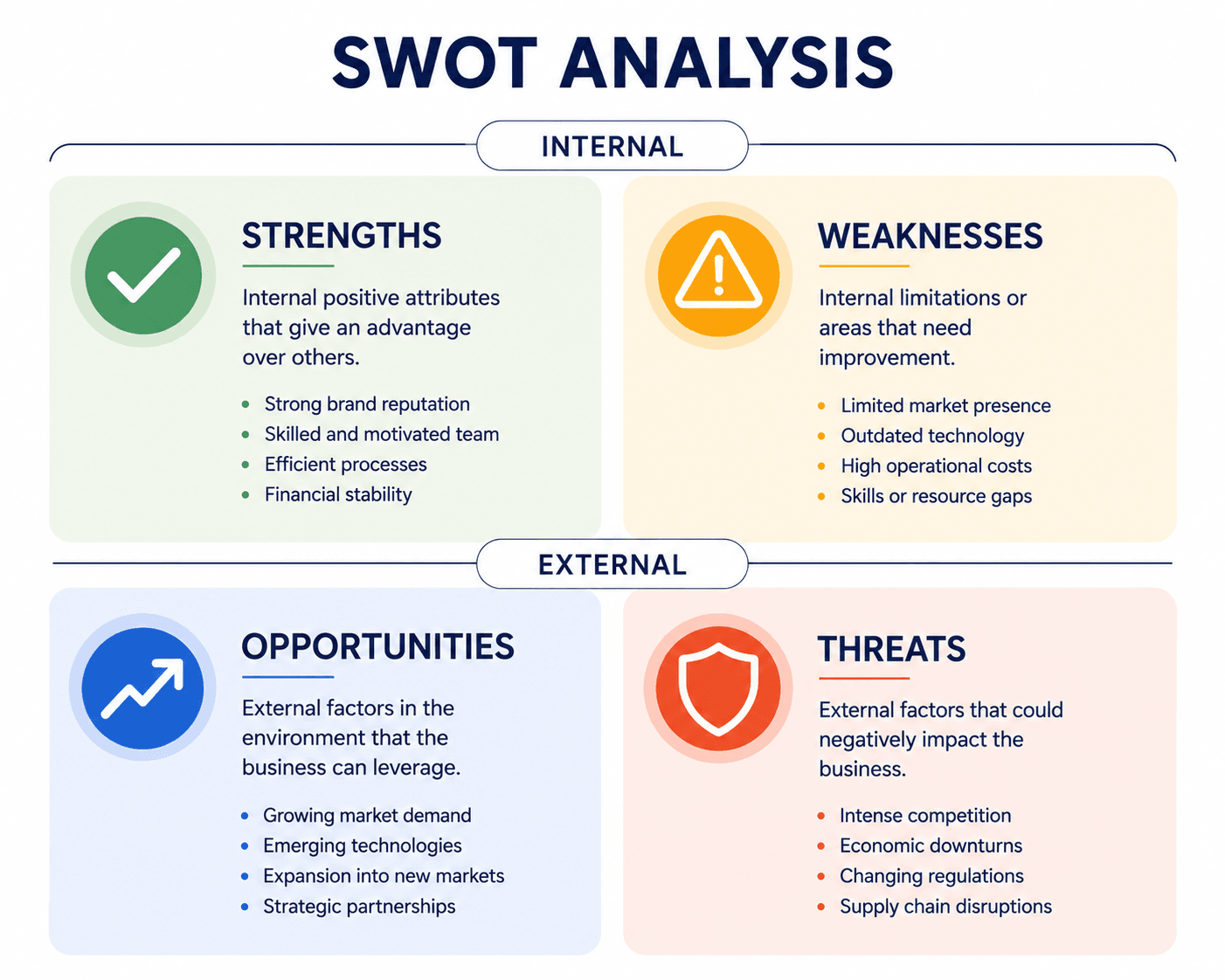
The framework is usually presented as a 2×2 grid, with Strengths and Weaknesses on top (internal) and Opportunities and Threats on the bottom (external). That visual layout is precisely why SWOT analysis is a useful tool for both quick strategic thinking and structured academic case studies: it forces you to separate what you control from what you don’t, which is the single most common error people make when they skip the framework and just list pros and cons.
SWOT works because it is deliberately simple. It doesn’t require specialist software, financial modelling, or industry data you don’t already have access to — just honest, evidence-backed observations sorted into the right box. That simplicity is also its biggest limitation, which is why later sections of this guide cover the TOWS matrix and how SWOT compares to more detailed frameworks like PESTLE.

Where SWOT Analysis Actually Came From
Most articles repeat the same line: Albert Humphrey invented SWOT analysis at the Stanford Research Institute in the 1960s. That story is only partly accurate, and knowing the real version matters if you’re citing SWOT’s origins in an academic paper.
A 2023 peer-reviewed study published in Long Range Planning — based on original SRI archives and interviews with people involved in the research — found that the technique began as SOFT analysis (Satisfactory, Opportunities, Faults, Threats) at the Stanford Research Institute in the mid-1960s, led by Robert Franklin Stewart rather than Albert Humphrey. Humphrey was a participant in the research, not its originator — the popular “Humphrey invented it” story traces back to a memoir he circulated decades later, not to the original 1960s project records.
The acronym itself also came later. The letters “SWOT” first appeared in print in 1972, in a paper by British consultant Norman Stait, and the four-box matrix most people picture today was added a decade after that, in 1982, when Heinz Weihrich introduced the TOWS matrix to turn the framework from a passive checklist into an active strategy tool. Separately, some business historians trace an earlier version of internal/external strategic evaluation to Harvard Business School Policy Unit professors George Albert Smith Jr. and C. Roland Christensen in the early 1950s, though that lineage is disputed and less directly tied to the SWOT acronym specifically.
For academic writing, the safest citation is the nuanced one: SWOT’s direct ancestor (SOFT) emerged from Stanford Research Institute corporate-planning research in the 1960s; the SWOT acronym appeared in print in 1972; and the now-standard four-quadrant matrix was formalized by Weihrich in 1982. Crediting Humphrey alone as “the inventor” repeats a claim that the original archival record doesn’t fully support.
The Four Elements of a SWOT Analysis
Each of the four SWOT categories asks a different diagnostic question. Getting the definitions precise — not just memorized — is what separates a useful SWOT analysis from a generic list.
| Element | Category | Core Question | Example |
|---|---|---|---|
| Strengths | Internal | What do we do better than competitors, and what resources give us an edge? | Proprietary technology, strong brand loyalty, skilled team |
| Weaknesses | Internal | Where are we exposed, under-resourced, or behind competitors? | High staff turnover, limited marketing budget, outdated systems |
| Opportunities | External | What market, technology, or policy shift could we capitalize on? | New regulation favoring your product, emerging customer segment |
| Threats | External | What external force could damage our position if left unaddressed? | New competitor entry, rising input costs, changing consumer behavior |
Internal vs. External Factors
The most common mistake in any SWOT analysis — student or professional — is placing an external factor in an internal box, or vice versa. If you can change it through internal decisions, it belongs on the top row. If it depends on the market, government, competitors, or economy, it belongs on the bottom row.
| Internal Factors (Strengths / Weaknesses) | External Factors (Opportunities / Threats) |
|---|---|
| Company culture and leadership | Industry trends and market growth rate |
| Financial resources and cash flow | Competitor actions and new market entrants |
| Brand reputation you’ve built | Regulatory and policy changes |
| Employee skills and staff turnover | Economic conditions (inflation, interest rates) |
| Proprietary technology or IP | Technological disruption in your sector |
A quick test: if you removed the organization (or person) entirely, would the factor still exist? Regulation and competitor activity would — those are external. Your team’s skill gaps would disappear along with the organization — that’s internal.
Free SWOT Analysis Template
Here is a blank SWOT analysis template you can copy directly into a document, or fill in interactively using our SWOT analysis template tool, which formats and exports the matrix as a clean diagram automatically.
| Strengths | Weaknesses | Opportunities | Threats |
|---|---|---|---|
| 1. 2. 3. 4. 5. | 1. 2. 3. 4. 5. | 1. 2. 3. 4. 5. | 1. 2. 3. 4. 5. |
Aim for four to six honest, specific points per quadrant rather than ten vague ones. A quadrant with a single strong, evidence-backed point is more useful in an assignment or strategy deck than one padded with generic filler — the kind of low-substance padding covered in our guide on what fluff text is and why it weakens academic writing applies just as much to SWOT bullet points as it does to essay paragraphs.
How to Do a SWOT Analysis: Step by Step
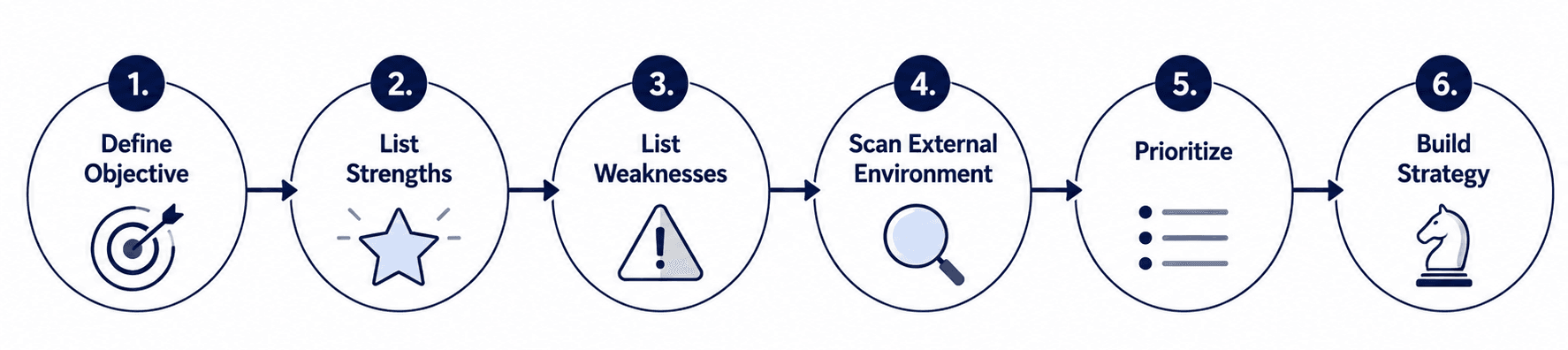
A SWOT analysis becomes weak when it’s treated as a brainstorm rather than a process. Follow these steps in order rather than filling all four boxes at once.
| Step | What to Do | Why It Matters |
|---|---|---|
| 1. Define the objective | Decide exactly what you’re analyzing: a company, a specific product, a market-entry decision, or your own career. | A vague scope (“the company”) produces vague, unusable results. |
| 2. List strengths honestly | Identify internal advantages, backed by evidence rather than opinion. | Unsupported claims (“we’re innovative”) don’t hold up under scrutiny. |
| 3. List weaknesses honestly | Identify internal gaps, even uncomfortable ones. | Hidden weaknesses resurface later as unmanaged threats. |
| 4. Scan the external environment | Research market trends, competitor moves, and regulatory shifts for opportunities and threats. | Opportunities and threats can’t be guessed from internal knowledge alone. |
| 5. Prioritize each quadrant | Rank points by impact; keep the top four to six per box. | A twenty-item list is harder to act on than a five-item list. |
| 6. Cross-reference into strategy | Match strengths to opportunities and weaknesses to threats (see the TOWS matrix below). | A SWOT grid alone doesn’t produce a decision — it only organizes information. |
SWOT Analysis Examples Across Contexts
SWOT analysis is used far beyond corporate strategy decks. The structure stays identical; only the content changes based on who or what is being evaluated.
| Context | Typical Strength | Typical Weakness | Typical Opportunity | Typical Threat |
|---|---|---|---|---|
| Business / Corporate | Strong brand recognition | High operating costs | Expansion into a new market | Aggressive new competitor |
| Startup / Product Launch | Fast, agile decision-making | Limited cash runway | Underserved niche demand | Well-funded incumbent players |
| University Case Study | Sourced from real financial data | Reliance on outdated reports | Industry growth trend | Regulatory change mid-analysis |
| Personal / Career | Strong analytical skills | Limited networking experience | Available internship programs | Competitive graduate job market |
If you’re building a personal SWOT specifically for career planning or a leadership assignment, our detailed walkthrough — examples of personal SWOT analysis for students — covers realistic strengths, weaknesses, opportunities, and threats with full sample statements you can adapt.
Turning Your SWOT Into Strategy: The TOWS Matrix
A completed SWOT grid describes your situation. It doesn’t tell you what to do about it. That’s the gap Heinz Weihrich’s TOWS matrix was built to close in 1982: it pairs internal and external factors to generate four categories of strategy.
| Strategy Type | Pairing | Guiding Question | Example |
|---|---|---|---|
| SO (Strength–Opportunity) | Strengths + Opportunities | How can we use our strengths to capture this opportunity? | Use existing brand trust to launch into an adjacent new market |
| WO (Weakness–Opportunity) | Weaknesses + Opportunities | How can we fix a weakness by taking this opportunity? | Use a new partnership to fill an in-house skills gap |
| ST (Strength–Threat) | Strengths + Threats | How can we use a strength to reduce this threat? | Use loyal customer base to defend against a new competitor’s pricing |
| WT (Weakness–Threat) | Weaknesses + Threats | How do we minimize a weakness so it isn’t exposed by a threat? | Cut costs in an underperforming unit before a downturn hits |
This is the step most assignments and case studies skip — and the one that examiners and managers actually want to see, because it demonstrates analysis rather than description.
SWOT vs. PESTLE vs. Business Model Canvas
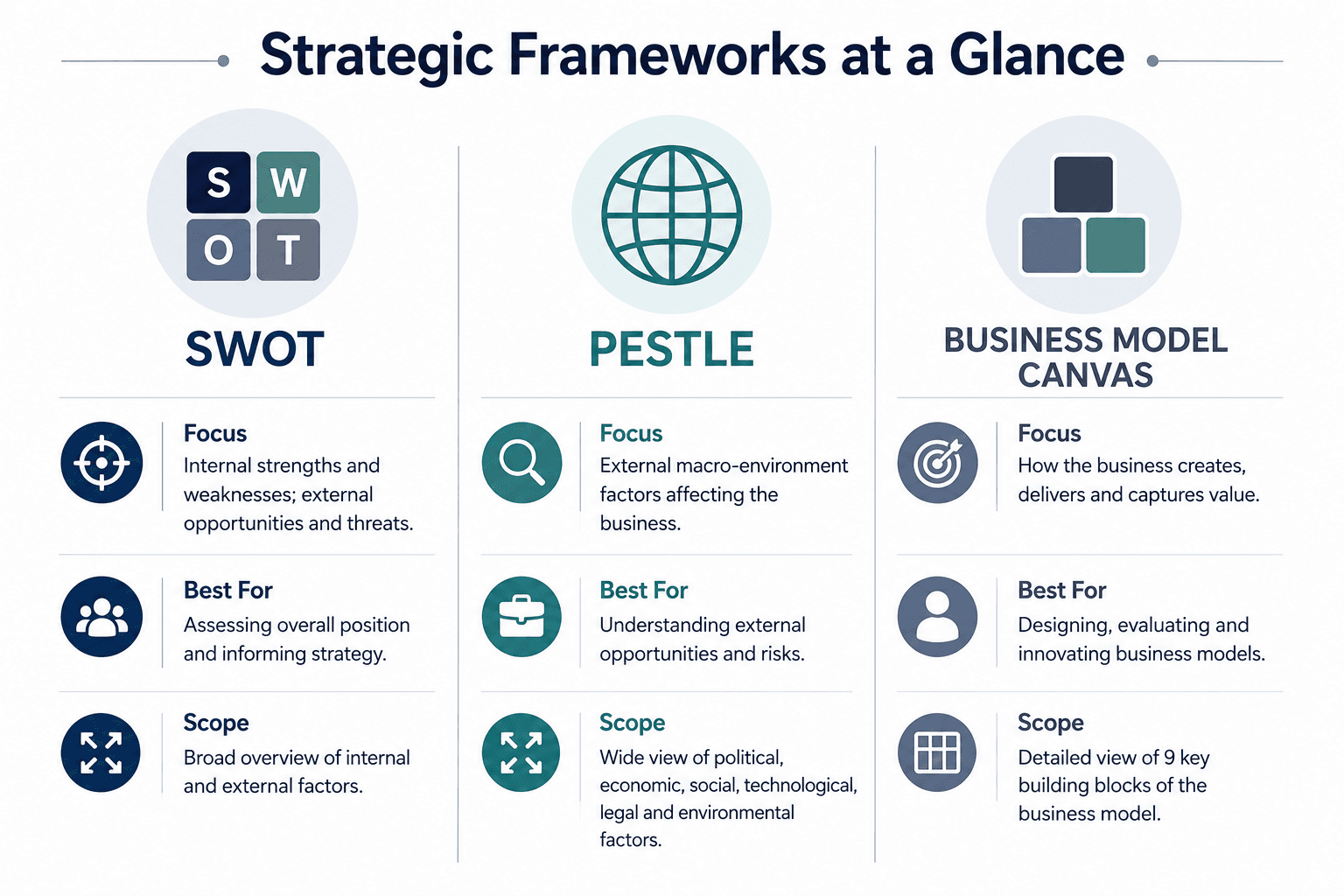
SWOT is often confused with, or used alongside, other strategy frameworks. Knowing when to use which one — or when to combine them — is a common assignment requirement.
| Framework | Focus | Best Used For | Internal or External |
|---|---|---|---|
| SWOT | Strengths, Weaknesses, Opportunities, Threats | Fast strategic snapshot of a specific business or decision | Both |
| PESTLE | Political, Economic, Social, Technological, Legal, Environmental | Deep dive into macro-environment factors affecting an entire market | External only |
| Business Model Canvas | Value proposition, customer segments, channels, revenue, cost structure | Mapping how a business actually creates and captures value | Mostly internal / operational |
In practice, the two Opportunities and Threats boxes in a SWOT are often populated using research first gathered through a full PESTLE analysis, since PESTLE breaks the external environment into six specific categories instead of one general box. If your assignment also requires mapping how the business actually operates — its channels, cost structure, and value proposition — our guide on how to write a Business Model Canvas for a university assignment walks through that companion framework in detail.
Common SWOT Analysis Mistakes
These mistakes appear in both student assignments and professional strategy documents, and they’re the fastest way to lose marks or credibility in a case study.
| Mistake | Why It’s a Problem | Fix |
|---|---|---|
| Listing opinions instead of evidence | “We’re the best in the market” isn’t verifiable or useful | Support every point with a fact, figure, or specific example |
| Mixing internal and external factors | Undermines the entire logic of the framework | Ask: “Would this exist without the organization?” |
| Stopping at the grid | A SWOT alone doesn’t produce a decision | Always follow with a TOWS matrix or action plan |
| Overloading each quadrant | Twenty vague points dilute the two or three that actually matter | Prioritize and cap each box at four to six points |
| Never updating the analysis | Markets and organizations change; a static SWOT goes stale | Revisit every quarter or after a major event |
The same discipline that keeps a SWOT analysis tight — cutting vague, padded statements — is the same principle covered in our guest piece on academic transition words and formal alternatives to “however”, useful once you’re writing up your SWOT findings as prose in a report or dissertation rather than bullet points. If your SWOT feeds into a broader time-boxed project plan, pairing it with a task priority matrix helps convert prioritized findings into a sequenced action list.
Free Online SWOT Analysis Tool
Manually drawing a four-box grid in Word or PowerPoint is where most of the wasted time in a SWOT assignment actually goes — not the thinking, the formatting. Our free SWOT analysis tool online removes that step entirely.
The online SWOT analysis tool gives you a live four-quadrant workspace: type your points directly into Strengths, Weaknesses, Opportunities, and Threats, and the layout, spacing, and formatting are handled automatically. When you’re done, export a clean PNG diagram ready to drop into a slide deck, Word document, or portfolio — or copy the text version straight into an assignment.
A few practical notes if you’re deciding whether to use it:
- It’s a free SWOT analysis tool online with no signup, no watermark, and no paywall on the export.
- Everything is saved locally in your browser — nothing is uploaded to a server, which matters if you’re working with confidential coursework or business data.
- It works equally well as a personal SWOT analysis tool for career planning and as a business-focused SWOT analysis strategic planning tool for case studies and reports.
- It’s a guided template, not an AI SWOT analysis tool that writes your content for you — you still supply the thinking, which is exactly what a lecturer or manager reviewing your work expects to see.
Frequently Asked Questions
What is a SWOT analysis in simple terms?
A SWOT analysis is a four-part framework that evaluates a business, project, or person by listing internal Strengths and Weaknesses alongside external Opportunities and Threats, giving a balanced snapshot before making a strategic decision.
Who invented SWOT analysis?
The popular story credits Albert Humphrey at the Stanford Research Institute in the 1960s. Archival research published in 2023 found the technique actually began as SOFT analysis under Robert Franklin Stewart, with Humphrey as a participant rather than the sole inventor. The SWOT acronym itself first appeared in print in 1972.
What are the four elements of a SWOT analysis?
Strengths and Weaknesses (internal factors you can control) and Opportunities and Threats (external factors shaped by the market or environment).
Is SWOT analysis only used for businesses?
No. It’s used for corporate strategy, product launches, university case studies, and personal career planning, using the same four-box structure with context-specific content.
What’s the difference between SWOT and PESTLE analysis?
SWOT covers both internal and external factors for a specific subject. PESTLE only covers external macro-environment factors, broken into six categories: Political, Economic, Social, Technological, Legal, and Environmental. They’re frequently used together, with PESTLE research feeding the Opportunities and Threats boxes of a SWOT.
Is this SWOT analysis tool free to use?
Yes. The SWOT analysis tool is completely free with no signup, and your data stays in your browser rather than being sent to a server.
What comes after completing a SWOT analysis?
Cross-referencing the four quadrants using a TOWS matrix, which pairs strengths with opportunities (SO), weaknesses with opportunities (WO), strengths with threats (ST), and weaknesses with threats (WT) to generate actual strategic options rather than just a description.
Conclusion: Key Takeaways
A SWOT analysis is only as useful as the discipline behind it. The framework itself is simple — four boxes, internal versus external — but the value comes from evidence-backed points, correctly sorted factors, and a follow-up strategy step like the TOWS matrix that most assignments and strategy decks skip entirely.
- Strengths and Weaknesses are internal; Opportunities and Threats are external — get this distinction wrong and the whole analysis loses its logic.
- The framework’s real origin traces to Stanford Research Institute research in the 1960s under Robert Franklin Stewart, not solely to Albert Humphrey as most sources claim.
- A strong SWOT prioritizes four to six specific, evidence-backed points per quadrant rather than a long list of vague statements.
- Pairing your SWOT with a TOWS matrix, or with a deeper framework like PESTLE, turns a description into an actual strategy.
- You can build, format, and export your own matrix in minutes using the free SWOT analysis diagram generator — no signup, no cost, no data leaving your browser.
Read Also:
- What Is the BCG Matrix? Definition, Examples & Free Growth-Share Matrix Tool
- What Is SWOT Analysis? Free Online SWOT Analysis Tool & Template
- How to Count Words in a PDF on Mac, Windows, or Online (No Software Needed)
- How to Find and Fix Passive Voice in Word, Google Docs, and Your Essay (Step-by-Step)
- Why Extra Whitespace Is Silently Wrecking Your Essay, Code, and Website